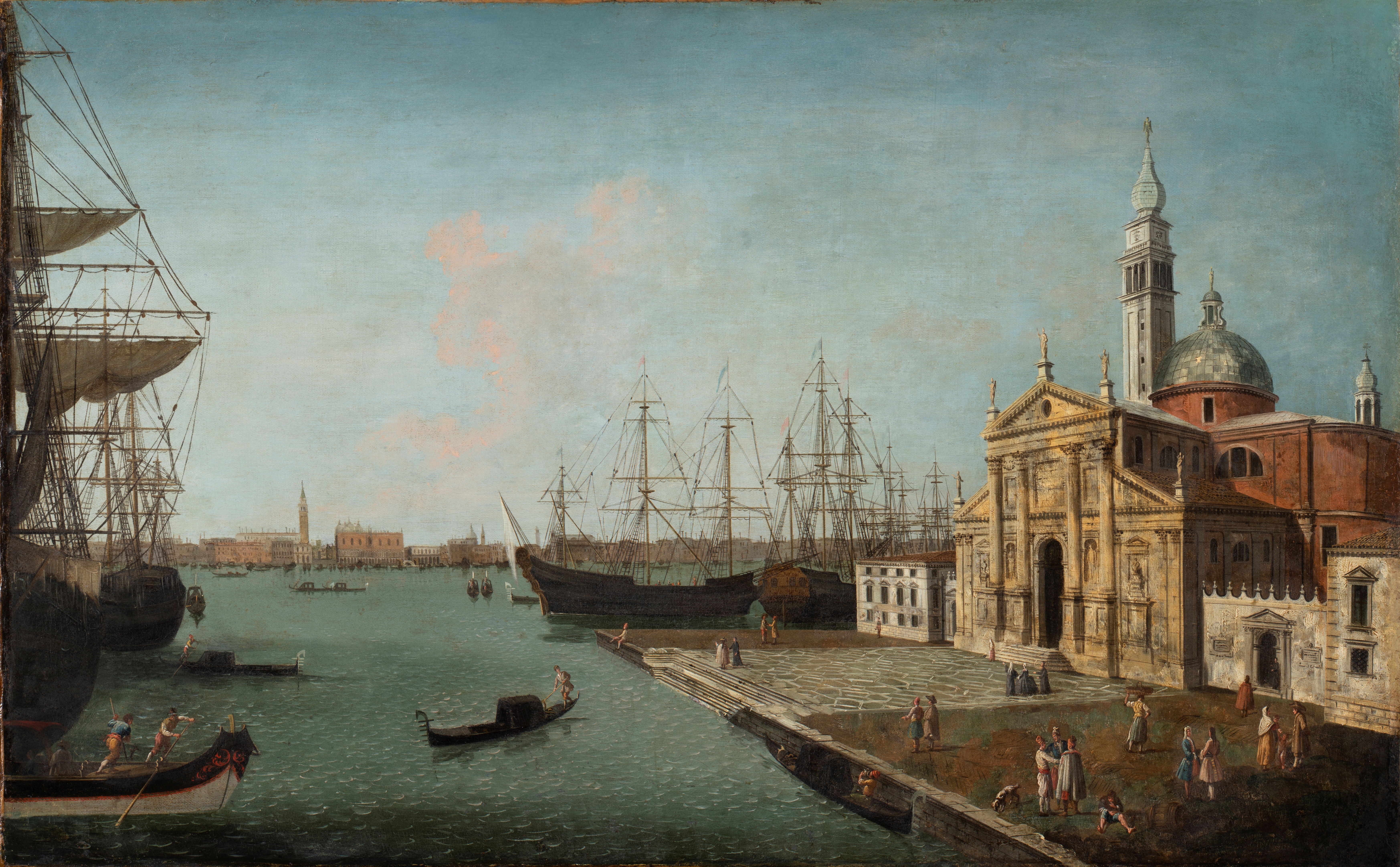
View of the Bacino di San Marco with the Doge`s Palace and the Riva degli Schiavoni in the distance, as seen from near the Church and Island of San Giorgio Maggiore
Marieschi, Michele
Venecia, 1710 - 1744
View of the Bacino di San Marco with the Doge`s Palace and the Riva degli Schiavoni in the distance, as seen from near the Church and Island of San Giorgio Maggiore, c. 1736-37
Michele Marieschi & Studio
Carmen Thyssen-Bornemisza Collection
Location: Thyssen-Bornemisza National Museum, Madrid
Oil on canvas
61,9 x 98,8 cm
CTB.2004.2
Artwork history
-
France-Hayhurst family (by inheritance), Bostock Hall and Bostock House, Cheshire.
-
Christie’s, London, South Kensington, Old Master Pictures, 21 April , 2004. Auction 6893. Lot 102.
-
Carmen Thyssen-Bornemisza Collection.
-
-Christie’s (aut. corp.): Old Master Pictures. [Auction cat.]. London, April 21st, 2004, lot 102, p. 127.
Expert report
This depiction of the south side of San Giorgio Maggiore, facing the Laguna and the distant Riva degli Schiavoni, including San Marco`s bell tower and the Palazzo Ducale was very dear to Marieschi, who repeated the subject many times (as a rule, with minor changes). One is reproduced in the collection of sixteen etchings (etching and burin) after his own ´vedute`, called: ´Magnificentiores selectioresque urbis venetiarum prospectus, printed in Venice in 1741, two years before Marieschi`s so untimely death.
The view bears the number 16 and reads: ´Ingressus in Urbem venienti e Clodia, cum insula S. Georgij maioris ad dexteram a longe Platea minor D: marci, cum proxima ripa Illyricorum`.
Compared to the Carmen Thyssen picture the viewpoint appears to be positioned slightly more to the right, with the monuments on Riva degli Schiavoni essentially confined to the left, and with some changes to the rendition of the gondole moored in the basin facing the island of San Giorgio. One gondola is shown heading southwards parallel to the quay near San Giorgio, whereas in the painting a gondola is placed orthogonal to it, heading towards a large vessel anchored to the left. A boat appears to be transporting goods from this ship towards the quay. More people in different groupings are standing on the ‘Fondamenta’.
This new version of the Veduta of San Giorgio Maggiore and the San Marco basin was hitherto unknown. The closest from the previously known group of such townscapes is the one in a private collection in Piacenza published by Montecuccoli degli Erri/Pedrocco in 1999 (cat. 84: oil on canvas, 60.5 x 96 cm), albeit judging from the illustration in that monographic work the quality does not seem to reflect the assertion, that it is „forse la migliore tra le varie redazioni del tema prodotte dal Marieschi“. Although both Montecuccoli degli Erri and Pedrocco claim this veduta is the earliest – and maybe the inspirational specimen for the etching – the absence in the background of the bell tower of the church of San Antonin, erected in 1738, suggests a date of approximately 1736/37, when Marisechi still made use of a ´pittura a macchia`, which is evident in the façade of the Palladian San Giorgio church.
This pictorial device appears to have been employed to a greater extent in the Carmen Thyssen example, particularly in the buildings adjacent to the façade.
The delightful feature of two vessels with repoussoir function on the very left edge of the composition, the furthest of them somewhat photographically cut, contributes to the appeal of the veduta and as such has been maintained by Marieschi in his etching. This compositional element is only lacking in one painting from the group, that in a private collection in London, published first by Ralph Toledano (1995, no. V.28a; Montecuccoli degli Erri/Pedrocco 1999, no. 115: oil on canvas, 58 x 86 cm). The close-up view of the Riva degli Schiavoni obliterates the section of skyline to the left of the Palazzo Ducale. On the whole this veduta seems to be the weakest of them all.
On the other extreme – so to say – of the compositional planning, we shall only mention the version that includes almost the entire vessel to the left, which is the one preserved in the Stiftung Schlösser und Gärten Berlin Brandenburg. A rather outstanding specimen (oil on canvas, 55 x 84 cm), one of six vedute by Marieschi – and according to some scholar from two different series, albeit all of the same dimensions and seemingly completed for one and the same patron, preserved today in the Charlottenburg Palace. Not only are two paintings from this series of canvases some of the best achievements by Marieschi (The Canal Grande merging in the Rio di Cannaregio; The Canal Grande in volta di canal), both embellished with marvellous figures by Antonio Guardi, but they are also the only works by him documented in the eighteenth century. In the present writer`s opinion, the Carmen Thyssen version is nearly as good as the one in the Berlin series, which is truly of rather arresting quality.
A further three versions of the theme, all of slightly lesser size than the Carmen Thyssen one, are of reasonable quality. One of those preserved in a private collection in Zurich (oil on canvas, 53,5 x 70,5 cm) was considered to be an authentic Marieschi by Toledano (1988, p. 43 color plate; 96-97 no. V.22.1 1995, pp. 94-95 no. V.28.1 with color plate) and Montecuccoli degli Erri/Pedrocco (1999, no. 155), whereas Manzelli (1991, plate A.15.2, p. 81 no. A.15.2) attributes it to Marieschi`s pupil Albotto, which is frankly hard to accept. According to Toledano the painting is a late work of about 1741-42.
The selected view offers more space to the left, thus the border vessel is imperceptibly more detailed, the distance to the Riva degli Schiavoni is shorter and the buildings to the left of San Marco`s bell tower are covered by the mainmast of the leading ship. A second boat with goods is depicted between the two vessels, whereas the gondola in the foreground is about to assume the diagonal position of the one in the new canvas.
Very similar to the latter and equal to the Carmen Thyssen specimen is the larger Veduta (even slightly bigger than the Thyssen one) sold at Sotheby`s London on July 4, 2012 (Lot 43: oil on canvas, 63,5 x 99 cm). It is possibly the most valuable of the whole series. Elements in common with the Sotheby`s picture are the marble surface of the quay and the position of the gondolas and other boats on the water. The second goods boat is lacking just like in the Thyssen canvas. The laguna space seems to open itself in a quite similar artful broadness: only San Marco`s bell tower seems higher and more imposing.
The third, truly magnificent example, sold at Sotheby`s London on July 2nd, 1986 (Lot 125: oil on canvas, 55 x 84 cm; then passed to the Matthiesen Gallery: was quite rightly considered to be an autograph painting by Marieschi by Toledano (1988, p. 96 no. V.22.2; 1995, p. 94 no. V.28.a with b/w image), Succi (in Gorizia 1989, p. 135 Fig. 146 in color) and Montecuccoli degli Erri/Pedrocco (1999, no. 112). Curiously enough Manzelli (1991, p. 81 with b/w plate A.15; p. 55) lists the painting twice under both Albotto and Marieschi. This must be attributed to a lapsus calami, since the quality of this veduta is a far cry from the modest talent of Marieschi`s pupil and heir of his master`s workshop.
It has to be pointed out that this particular view appears to be specific to Marieschi, since it was not painted by any vedutista prior or contemporary to him, and – as we have seen – it is a view that Marieschi returned to on a number of occasions. However, it was not only appreciated by Marieschi, if we consider that even after his lifetime the motif remained popular thanks to the Prospectus engraving of 1741. Among the frequently very mediocre spin-offs, one should mention the quite naive version attributed to Gabriel Bella (oil on canvas, 71 x 94,7 cm), included in the last Dorotheum auction catalogue (Vienna, Dorotheum, Old Master Paintings, Part II, 11 November 2021, Lot 390).
Were we to create a ´league table` of the many versions we have discussed so far, it appears clear that despite the cautious label in the auction catalogue (´Michele Marieschi and Studio`) the Carmen Thyssen canvas belongs to the best three depiction of this particular subject invented by Marieschi.
The Matthiesen picture is the one that betrays a more lively, free rendering for both the varied renditions of vessels, boats and gondolas, reflecting an imitation of real life on the Bacino di San Marco, spectacularly illustrated by the ship with open, full, white sails to the left of the composition. Even the audible hubbub of the crowds on the quay is convincing captured: sketch-like tiny figures recall the macchiette by Giannantonio Guardi. On the other hand the Sotheby`s 2012 and the Carmen Thyssen examples bear the stigma of a sort of abstract mise en page, particularly the latter, drawn under the geometric contours of those skeleton-like ship masts. However, worthy of praise are the figures displayed in the Sotheby`s canvas, the only ones among which oriental types are included. Those of the Carmen Thyssen version are slim and sketchy, and evidently belong to Mariesch`s own simplified way of depicting characters.
It is in fact a long and troublesome story for the one who aims to identify the hand of a figurista amidst Marieschi`s compositions. Toledano, for instance, has proposed the name of the battle specialist Francesco Simonini as the one responsible for the crowds in the Sotheby`s painting. All this does not appear immune of a certain arbitrary method, since in the case of the many – so to say – nondescript small figures, one wonders why the vedutista felt the necessity to collaborate with a specialized colleague for such an irrelevant percentage of his veduta.
This may possibly have been the explicit request of the customer as was the case for the most glorious achievements by Marieschi. It is enough to refer to the magnificent pair of Vedute once the property of King Friederich II of Prussia (now Stiftung Schlösser und Gärten Berlin-Brandenburg), dedicated respectively to The Canal Grande merging in the Rio di Cannaregio and the Canal Grande in volta di Canal. In both canvases the role of the now larger figures is much more striking, their attitudes and movements quite convincing and spontaneous, their rendering freely pictorial, the brushstrokes thick. Here it would be hard to imply that Marieschi was imitating a figure specialist, hence the name of Giannantonio Guardi as the figurista appears – as we have already stated – to have been very reasonably suggested by Antonio Morassi.
In overall the execution of the Carmen Thyssen canvas appears most typical of Marieschi, specifically in the white curl-like signs hinting to the waves in the lagoon waters and the habit of defining buildings and boats in a very sparing manner, through a few marks (for instance as regards the two gondole represented almost in the middle of the view, orthogonal to our perspective.
Some small portions of the scene seem to have been repainted, like the gondola in the middle lower area, as for some three quarters of its surface from left to right. The lower right square of the composition appears to have been heavily retouched (or repainted?), as is the case of a stripe of c. ½ cm in height to the left and of c. 1 cm to the right: these are probably all old repainted losses. The reddish paint on the right transept of the San Giorgio Maggiore church bears traces of damages, possibly repainted or retouched.
Impressive are the previously mentioned lumps of white on the buildings, which follow the façade to the right, a device which sounds atypical for a copyist and maybe even for a studio follower. These recur in the white garments of the attendants on the quay. Another peculiarity is the presence of parallel diagonal short black signs, which may have had the function of outlining some features that were then not carried out. These devices are readily detectable to the right of the group of three gentlemen in foreground on the quay and behind the seated boy with brown jacket and blue trousers. These parallel marks can also be found in the View of the Canal Grande with the Salute at the Louvre. (Montecuccli degli Erri/Pedrocco 1999, no. 115).
The painting, which shows an old lining, would certainly benefit from a light cleaning, particularly with regards the yellowish façade of the church of San Giorgio.
All in all, this version of a beloved Marieschi subject turns out to be among the three best known so far. Possibly the third best. Indeed, a fair acknowledgement for an appealing picture, even if not eligible to be classified as the prime specimen of the depiction of the Bacino di San Marco seen from Chioggia, with the island of San Giorgio with its homonymous church to the righthand side.
To my eyes a competent work by the master who died young, not necessarily with workshop intervention and can by no means be attributed to his modest pupil Francesco Albotto, whose inflated catalogue – one should remember – refers solely to one signed picture of rather deceiving quality.
Roberto Contini