The fields at night
Castellanos, Carlos Alberto
Montevideo, 1881 - 1945
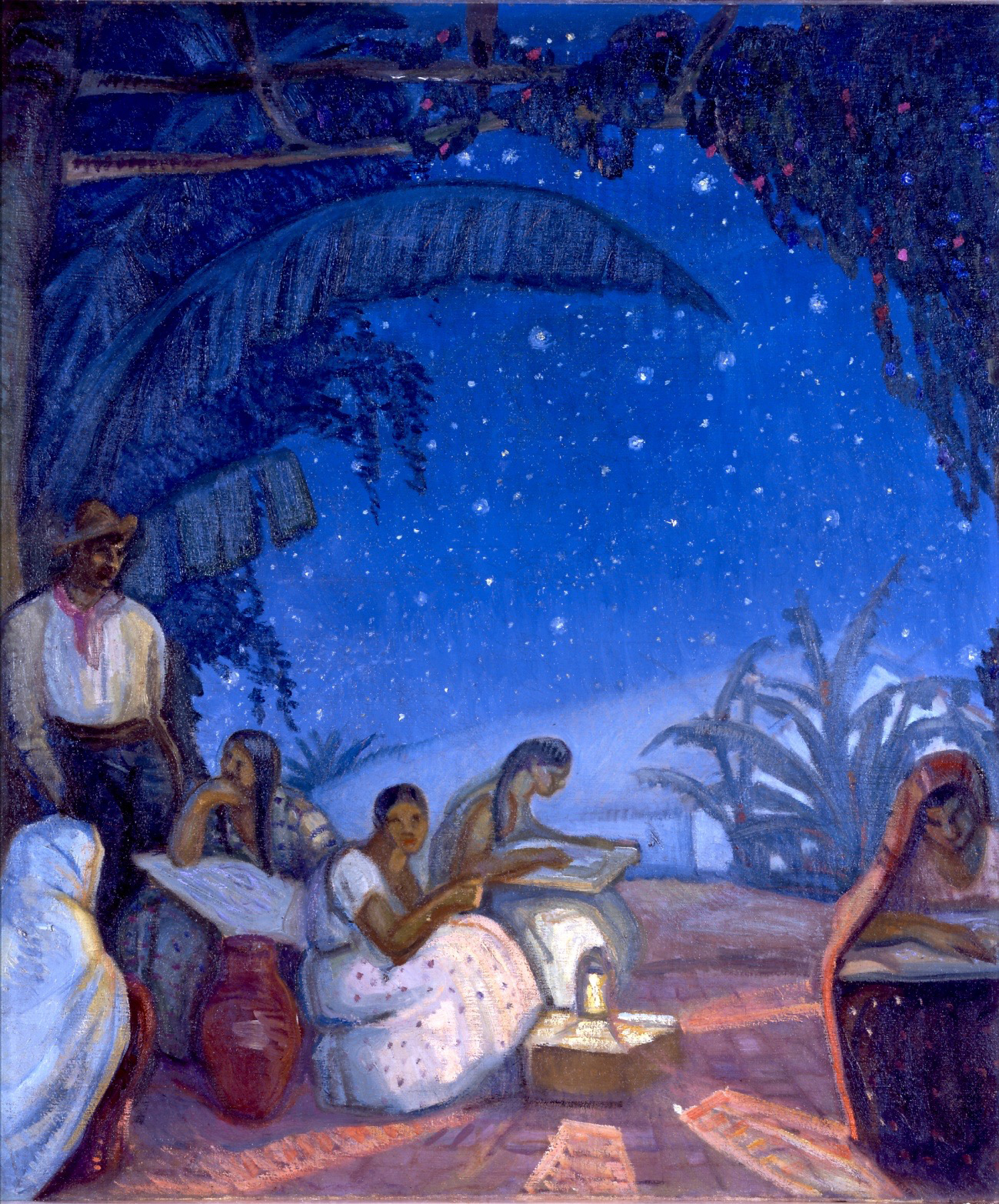
The fields at night, n/d
Carmen Thyssen-Bornemisza Collection
Oil on canvas
99 x 101 cm
CTB.2005.3
Artwork history
-
Sur Gallery, Montevideo, Uruguay, February 4, 2005
-
Carmen Thyssen Bornemisza Collection
-
– Sons. Analogías musicales en la pintura. Museu Carmen Thyssen Andorra [Exhib. Cat. Curator: Giró, P.], Ed. Fundació Museu Andorra (Museand), 2024. P. 30, 31, 81, 118, 119, 200 & 201 [Sheet by Pilar Giró]
Expert report
Carlos Alberto Castellanos work reveals the personality of an artist attentive to the new aesthetic languages that had been developing since the beginning of the twentieth century. A broad outline of part of his biography provides important insights into understanding how he constructed and incorporated this learning into his painting.
At the age of twenty-three, he left his native Montevideo a travelled to Europe to see the artistic avant-garde first-hand. We know that during his time in Madrid in 1904 he attended painting classes with Joaquín Sorolla. The work here, The Fileds at Night, is an example of his mastery of the use ” white and the application of luminism, although in a style far removed from that of his master. Castellanos showed that he could bring his own personality to all the knowledge an influences he received.
After a brief stint in South America, which coincided with his participation in 1910’s Exhibition for the Centenary of the May Revolution, he returned to Europe. On this second journey another encounter took place that should be considered in the analysis of this work. He met the painter Anglada Camarasa. who in 1914 formed a veritable colony of artists fleeing the Great War and joined them on the island of Mallorca.
The Fields at Night is a harmonious composition combining verism and a certain poetic and idealised vision of nature with the use of a strong chromaticism that allows us to draw parallels with the Catalan master’s freedom in the application of colour. The theme of this work also enables us to establish links with Camarasa, who focused on depicting peasant and coastal environments during his stay in Pollença.
After the war, Castellanos returned to Paris and remained there until 1929, when he decided to move home and settle permanently in Montevideo. lt is very likely that he produced this work during that period. Aesthetically, it can be interpreted as a compendium of learnings, having assimilated the languages of the European avant-garde to speak with his own voice. For Castellanos, the extreme landscapes of America proved an excellent setting for his painting.
The Fields at Night shows a group of peasants whose clothing and features, as well as the plant life and architecture, easily place it in Uruguay. A starry night evokes the post-impressionist language of Van Gogh, with weavers suggesting the paradises of Gauguin’s Tahiti and Martinique. A bucolic scene of Noucentisme scents, narrated with a beautiful modernist chromaticism, the light as hypnotic as the gaze of the girl who discovers the spectator contemplating her while the rest of the characters remain absorbed in their tasks and conversations.
Pilar Giró