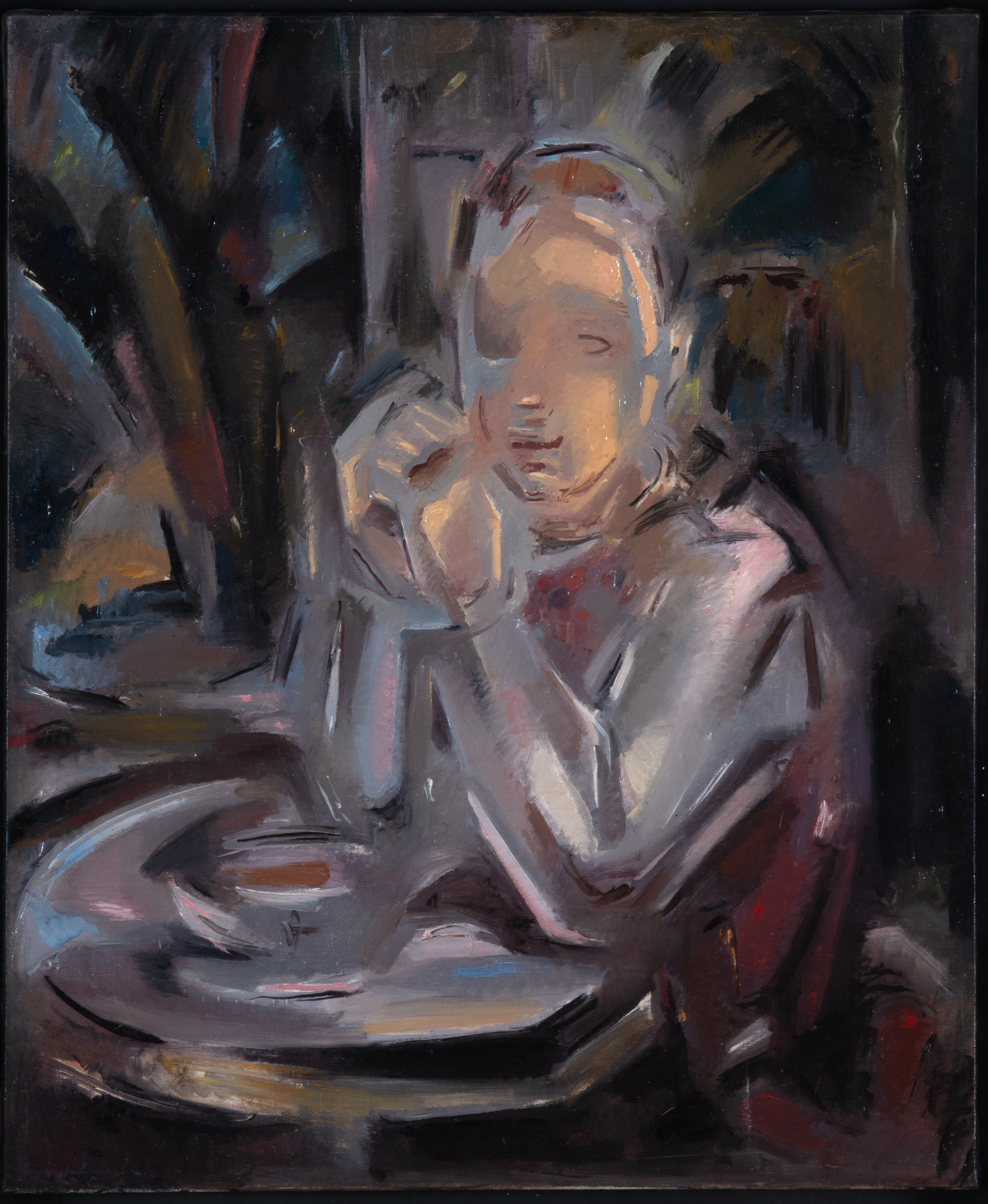
Young man sitting at a table in front of a cup
Blanchard (Gutiérrez Blanchard), María
1881, Santander - 1932, Paris
Young man sitting at a table in front of a cup, women, 1931-32
Unsigned
Carmen Thyssen-Bornemisza Collection
Oil on canvas
73 x 60 cm
CTB.2021.30
Artwork history
-
Artist’s Athelier
-
Carmen Gutierrez Blanchard
-
Private collection, París
-
Segre Auctions, Madrid. Auction June, 2021. Lot 302
-
Carmen Thyssen-Bornemisza Collection
-
– Caffin Madaulo, L.: Catalogue Raisonné. Vol I. Ed. Museo de Arte Español Contemporáneo, Madrid, 1982, rep. p. 36.
-
-Salazar, M.J.: Catálogo Razonado, Museo Nacional Centro de Arte Reina Sofía, Ed. MNCARS, Madrid, 2013, rep. p. 306-307, nº 332.
-
-María Blanchard. A Painter in Spite of Cubism [Exhib. Cat.]. Ed. Foundation Museo Picasso Málaga. Legacy Paul, Christine & Bernard Ruiz-Picasso. Junta de Andalucía, 2024. P. 183.
Expert report
We can research in the artistic trajectory of Maria Blanchard, (1881-1932), a time of formation and search, entering later with force and personality in cubism to finally around 1920 she takes up again as the center of her production, the figure in which the survival of Cézanne can be glimpsed.
In this, her last stage, of return to order, she recurrently conceives pieces of great quality in which she likes to capture images of children or young people, located in timeless spaces, which derive from the great classics of painting, always in their immediate environment, in the context of their own home.
As can be seen in this work, she is indebted to cubism, in her structures and even in the strong volumes with which she composes the figure; she represents the young woman, as in previous works, facing the spectator in a three-thirds view; an original and personal way that she adopted, since her beginnings in Manuel Benito’s workshop, in her formative years in Madrid.
The break with the solidity of the previous representations, the looseness in its execution, as well as a chromatic liberation, indicate an advanced date of creation.
Interesting work, great composition, somewhat unfinished; the image of this young woman, abstracted in sorrowful thoughts, oozes sensitivity, sweetness and sadness; there is always something autobiographical in these compositions.
Maria Blanchard had this painting in her studio at the time of her death, as attested by the photographs preserved from that time.
María José Salazar