Los Angeles
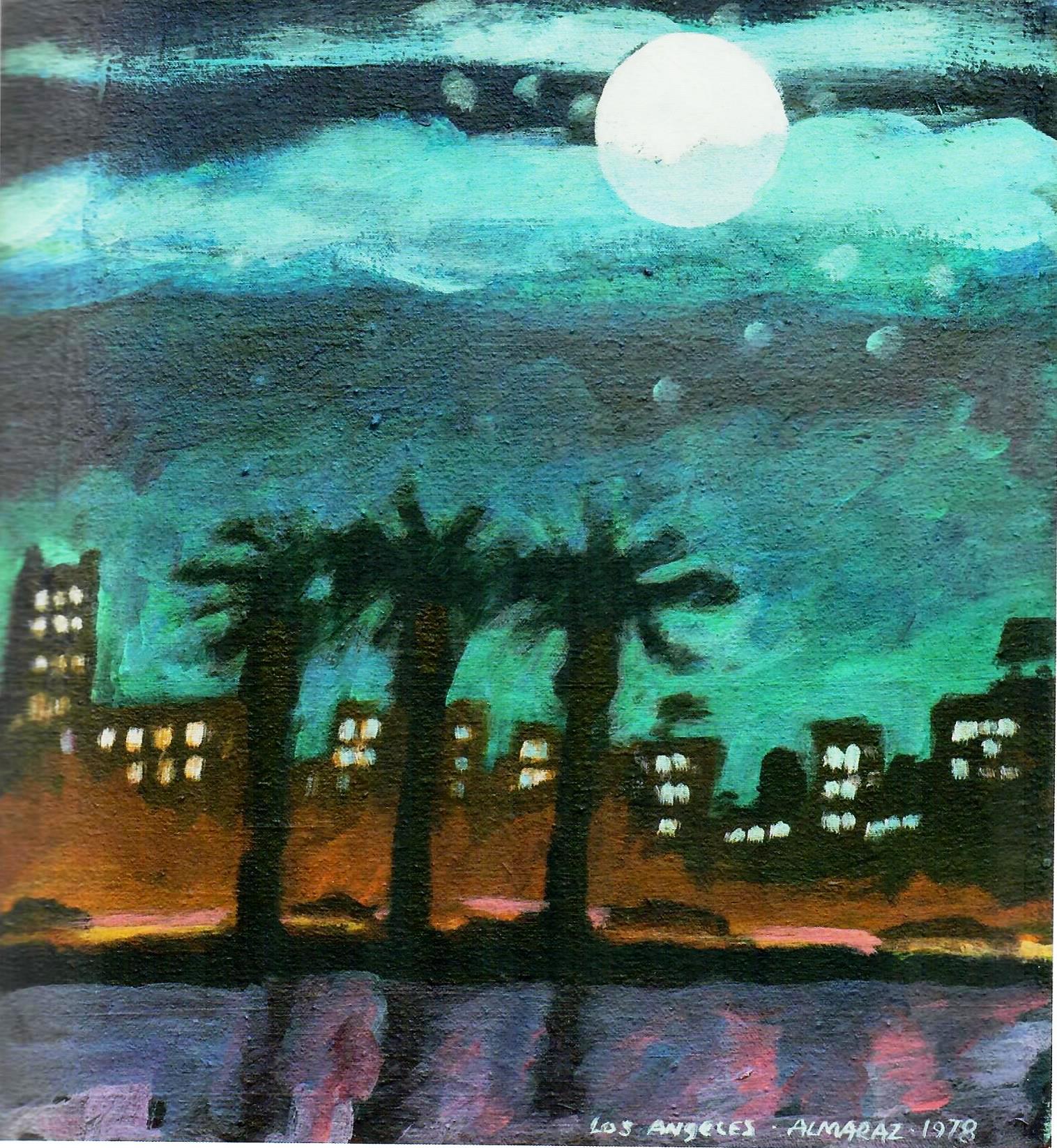
Almaraz, Carlos
1941, Ciudad de México - 1989, Los Ángeles
Los Ángeles, 1978
Titled, signed & dated lower right : "Los Angeles/ Almaraz, 1978"
Carmen Thyssen-Bornemisza Collection.
Oil on canvas
38 x 38 cm
CTB.2020.18
Artwork history
-
Subarna Auctions, Barcelona, March 12, 2020, lot 859.
-
Carmen Thyssen-Bornemisza Collection.
-
– KHRÔMA. El Universo emocional del color. Museu Carmen Thyssen Andorra [Exhib. Cat.], Ed. Fundació Museu Andorra (Museand), Principado de Andorra, 2023. P. 16-17, 101 y 165 [Sheet by Guillermo Cervera]
Expert report
Commentary of the picture:
The 1970s were an intense period due to the reactions against various situations experienced by the United States at the time. The Vietnam War caused a social backlash and hippy revolution, seeking answers to the social violence caused by the war and racial segregation and imagining alternativas based on peace. California, especially San Francisco, was at the centre of this struggle for the social acceptance of different groups such as immigrants or homosexuals. Together with cities like Chicago, the city of San Francisco opened its doors to integrating groups that were rejected by other states.
Los Angeles, with a large Mexican community, saw how the numbers of Spanish-speaking inhabitants grew but were unable to move up in the world. Hollywood, the movie capital of the world, covertly supported this segregation, evident in the scarcity of Hispanic actors with few parts in films and only secondary or minor roles. Within this situation, there appeared a group of visual artists known as Los Four (Spanish “The” and English “Four”) with the goal of introducing Chicano (Mexican American) art into all strata of conventional art. This group worked together to develop different works of art and won the respect of the critics, something that many artists struggled to achieve.
Consisting of Carlos Almaraz, Frank Romero, Robert de Rocha, Gilbert Luján and later, Judithe Hernández, the group artists was soon welcomed by art galleries and allowed to hold a group exhibition at Los Angeles County Museum in 1974,the clímax of their career.
Carlos Almaraz was born in Mexico in 1941 and grew up between Chicago and Los Angeles. He moved to New York to attend the Otis College of Art and Design, where he developed his painting skills. On his return to Los Angeles, he was quick to gain a foothold in the world of Californian art but always hampered by being an immigrant. For this reason, he created the group Los Four with his fellow artists. Almaraz’ work is defined by its intensity and great force, which is why he is still a reference for Mexican-American artists today.
In his work Los Angeles, 1978, Almaraz creates a small-scale idyllic view of the city around him, in this case Echo Park, the district where he and many other artists lived.
In this canvas, you can easily recognise the lake in the park with its characteristic palm trees and the line of buildings around the park. In his typically intense style, Almaraz achieves a work in which the saturated textura produces a blurred effect. His use of colours, very similar to the Pop Art that was flourishing in New York over those years, produces a strong contrast between the city’s urban area, shadows and the night sky. You can see the Surrealist aspect that accompanied the artist throughout his career. In his period following the defence of Mexican civil rights in the USA, the artist seeks a much more personal form of expression, as reflected in the work Los Angeles, 1978.
His combination of works on canvas and the large murals that e painted in the city (with the theme of the defence of Mexican-American civil rights), made Almaraz a role model for the immigrant population of southern California within his lifetime and, eve now after his death in 1989, his name is still a point of reference in the Bear Flag state.
Guillermo Cervera