Still-Life with watermelon
Cossío, Pancho
San Diego de los Baños, Cuba, 1894 - Alicante, 1970
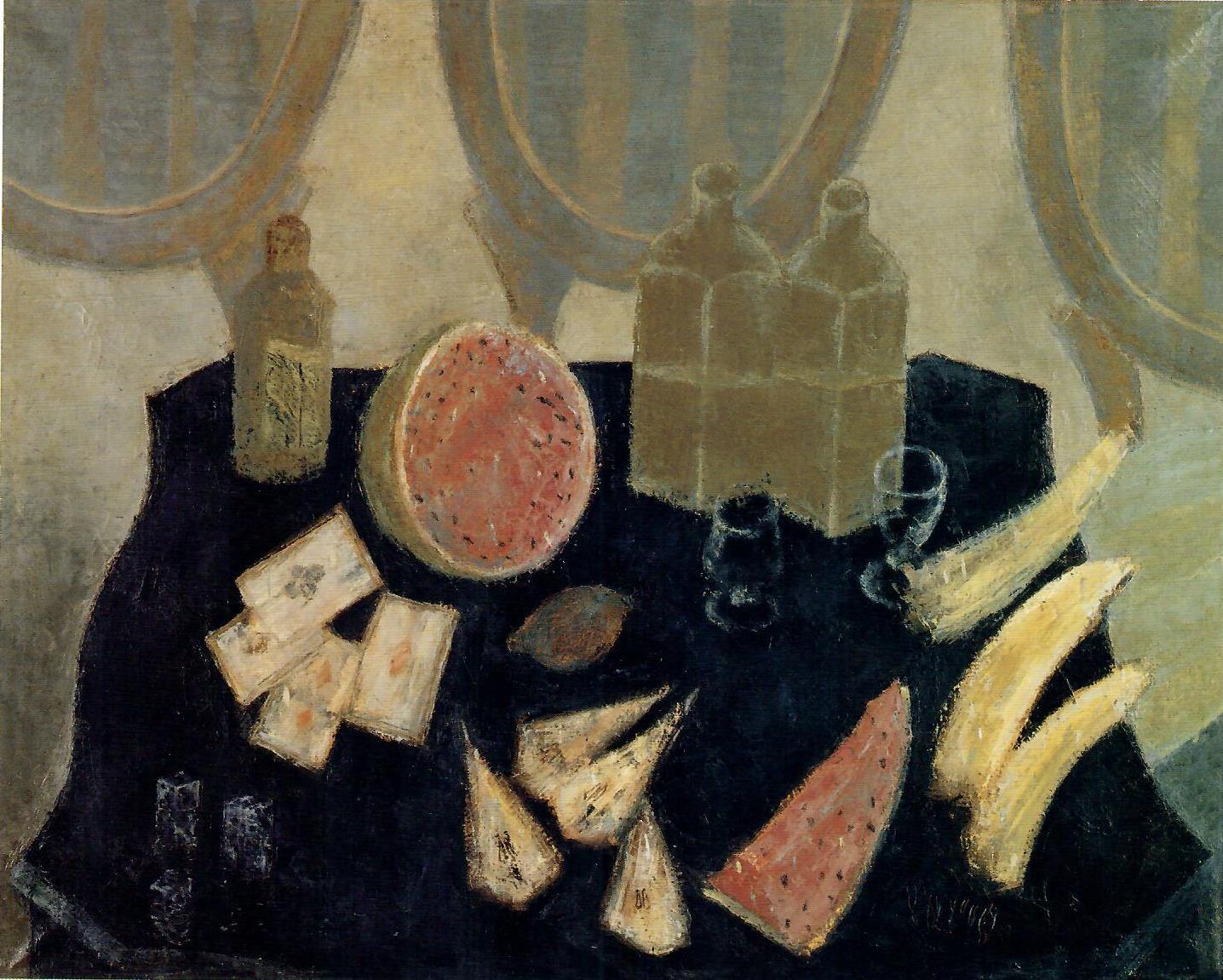
Still-Life with watermelon, c. 1962-1964 (Bodegón de la Sandía)
Signed lower right: 'P. Cossio'
Carmen Thyssen-Bornemisza Collection.
Oil on canvas
81 x 101 cm
CTB.1999.44
Artwork history
-
Artelandia, Madrid.
-
Ansorena Auctions, lot 103, Madrid, March 23, 1999.
-
Carmen Thyssen-Bornemisza Collection.
-
-La tradición moderna en la Colección Carmen Thyssen. Monet, Picasso, Matisse, Miró. [Exhib. Cat. Museo Carmen Thyssen Málaga]. Málaga, Fundación Palacio de Villalón, 2011, p. 172, lám. p. 173 [Sheet by Inés Vallejo].
-
– KHRÔMA. El Universo emocional del color. Museu Carmen Thyssen Andorra [Exhib. Cat.], Ed. Fundació Museu Andorra (Museand), Principado de Andorra, 2023. P. 24, 25, 104, 170 y 171 [Sheet by Inés Vallejo].
-
–Latent Modernity. Avant-garde and Innovative Painters in Spanish Figurative Art (1920–1970). Telefónica Collection. Museo Carmen Thyssen Málaga [Exhib. Cat. ]. Ed. Fundación Palacio de Villalón, 2024. P. 168-169.
Expert report
After Cossío’s first solo exhibition at the Ateneo in Santander in 1921, thepoet Gerardo Diego, writing in the pages of the newspaper El Diario Montañés, advised the painter to travel beyond our years later, with the painter to travel beyond our borders. Two years later, with the help of the sculptor Daniel Alegre, Cossío settled in París. There, in the French capital, he came into contact with the Spanish artists who moved there during the 1920s: Ismael González de la Serna, Manuel Ángeles Ortiz, Joaquín Peinado, José María Ucelay, Alfonso Olivares, Luis Fernández, Francisco Bores and Remando Viñes. With the last two, he worked on lyrical figuration, which was praised by the critic E. Tériade who called it Neo-Fauvism, a style that seeks pure, more spontaneous results from the typical elements of painting.
Francisco Bores defined this new painting as a synthesis of the demands of lyricism and the work of Cézanne and Braque. Far Cossío, as with others of his contemporaries, the influence of the Cubist master was essential. In the 1920s, Braque was proposing a means to escape repetitiva Cubist codification which was seized on by young Spanish painters living in Paris.
In 1926, Pancho Cossío began to work on one of the themes that would dominate his production and in which his artistic language would blossom: still lifes, borrowed from the Spanish painting tradition and Cubist imagination. The painter approached them through a figurativa lyricism full of bottles, glasses and playing cards, the quintessential elements of Cubism, but also all kinds of fruit and a wide variety of objects. lt was within this theme that Cossío achieved the synthesis of his language, especially in his still lifes dating from the 1940s.
In the 1960s, the still lifes reached their zenith, as seen in Still-Life with Watermelon. This work is like a compilation of his career. On the one hand, we see the presence of sorne of his typical objects, including his habitual, ghostly pears and the watermelon of the title; on the other, the spectrality of the forms, the limitad palette of colours and the raised viewpoint, which make this painting a glossary of his artistic lexicon. Equally, the table in the centre of the composition demonstrates his debt to the tables in Braque’s work of the 1920s. Still-Life with Watermelon also refers back to Cossío’s own career, as we can find traces of both Two Tables (1954) and the rotundity of The Great Table (1962), works that also contain a black side table and received awards at the National Fine Arts Exhibition in the year that each was painted.
Inés Vallejo