Portrait of a Girl with Doll
Sorolla y Bastida, Joaquín
Valencia, 1863 - Cercedilla, 1923
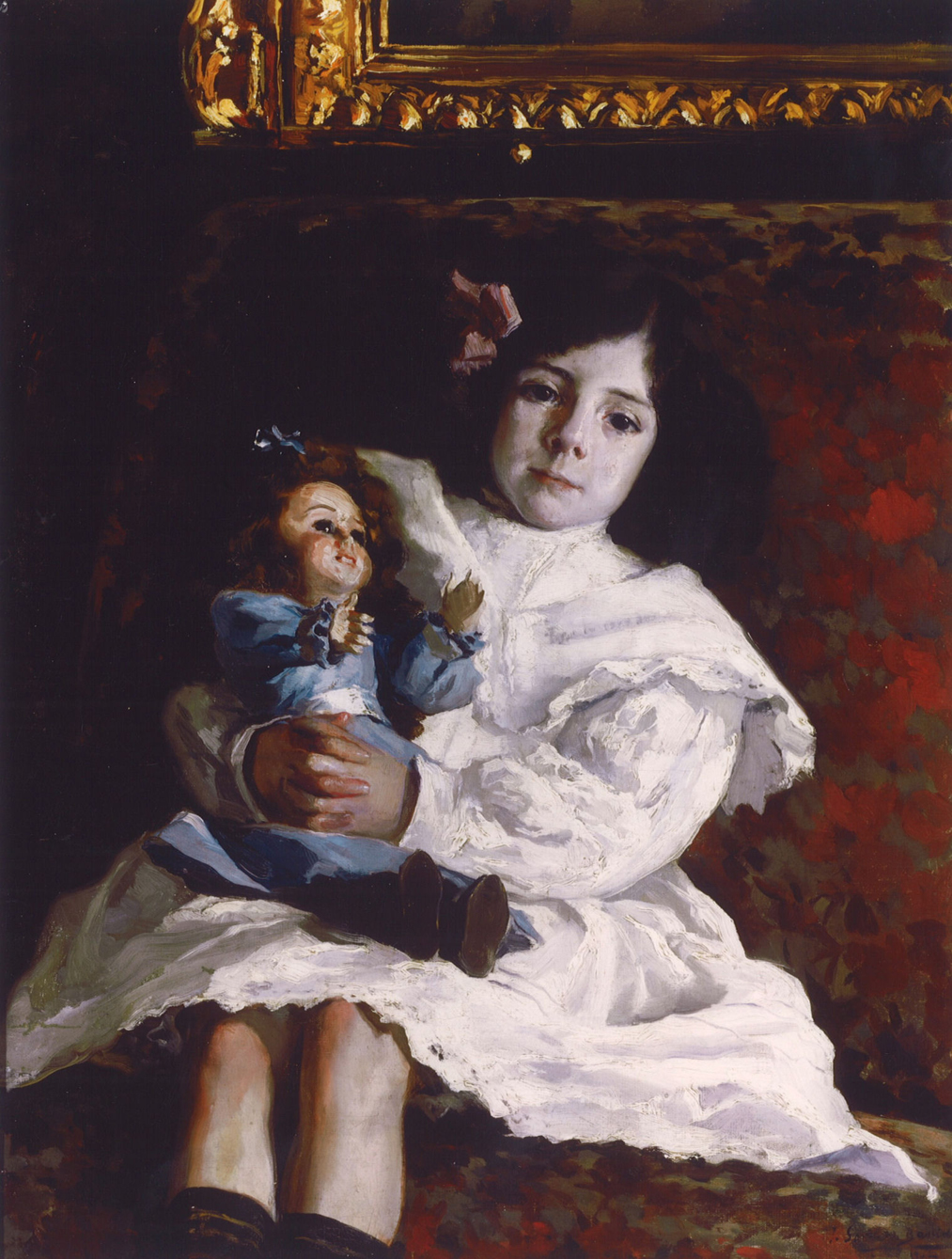
Portrait of a Girl with Doll, 1902
Signed & dated lower right:: "J. Sorolla Bastida/ 1902"
Carmen Thyssen-Bornemisza Collection
Oil on canvas
80 x 60,5 cm
CTB.1999.26
Artwork history
-
Private Collection, Switzerland.
-
Sotheby’s, New York, May 5, 1999. Lot 360.
-
Carmen Thyssen-Bornemisza Collection.
-
-Del impresionismo a la vanguardia en la Colección Carmen Thyssen-Bomemisza. [Exhib. Cat.]. Barcelona, Centre Cultural Caixa Catalunya, 1999-2000 , p. 88, lám.
-
-De Corot a Monet. Los orígenes de la pintura moderna en la Colección Carmen Thyssen-Bomemisza, Valencia, Museo del Siglo XIX, [Exhib. Cat. Valencia], 2000, p. 160.
-
-L’impressionisme i la selva empremta en la col·lecció Carmen Thyssen-Bomemisza, Andorra, Sala d’Exposicions del Govern d’Andorra, [Exhib. Cat. Andorra],2000, p. 108.
-
-Sorolla y la pintura valenciana en la Colección Carmen Thyssen-Bomemisza, Los Arcos (Navarra), Casa de Cultura Carmen Thyssen-Bornemiza, [Exhib. Cat.. Navarra], 2004, p. 42 y 43.
-
-La edad dichosa. La infancia en la pintura de Sorolla. Museo Sorolla, Madrid [Exhib. Cat. Ed. Martínez Requena, S; Pitarch Angulo, C.], Fundación Museo Sorolla, Palacios y Museos Ediciones, Madrid, 2022. Cat. 17, p. 94-95.
Expert report
Within the art of Joaquín Sorolla, the portrait forms an important group in terms of both quantity and quality. Portraits of children, to whom Sorolla was so accustomed since his own children were permanent models from birth, are works he liked to paint. There are many portraits of his small children and many notes in which his children play the leading part. There are may portraits, too, of the children of friends: many posing with one or both parents.
Six of Sorolla’s portraits are of girls posing with dolls. In the first, The Three Daughters of Rafael Errázuriz, painted from a photograph in 1898, the smallest girl holds a Chinese doll in her hand, the same doll that figures in the Portrait of María Teresa García Banús, Sorolla’s niece, painted around 1900.
In the other three, the model was his youngest daughter, Elena. Two of these were painted in 1906 in El Pardo, ene being a study fer the other: Elena in El Pardo. Study and Elena in El Pardo. In both, the girl pushes a pram with her dolls. They are painted outdoors and rather than portraits are both compositions with a figure, which is common when his children were posing. The third, Elena and her DolIs, painted in 1907 in La Granja, seems little like a portrait, similarly to the two other works, and was also done outdoors.
This Portrait of Girl with Doll, painted in 1902, is the third in arder of execution, and is a true portrait. The girl, dressed in white, cradles a doll which plays as important a role as the girl herself, suggesting that it was not the painter’s decision to have the girl pose with her doll, but rather the girl’s to be painted with her favourite doll. To judge by her features, the girl might have been ene of Sorolla’s nieces, but the fermality of the portrait speaks more of a commissioned portrait than of a family member, sin ce the latter usually have freer composition and brushwork. The girl’s position and her attentive look suffice to reflect her character.
By the time Sorolla painted this portrait, he had already achieved ali the honours and awards that an artist could wish fer. In 1900, he had won the Grand Prix at the Exposition Universelle in Paris. In 1901, he had been awarded the medal of honour at the Exposición Nacional in Madrid and the same year he had been given the Cross of the Légion d’Honneur by the French Government and made a member of the French Académie Francaise des Beaux-Arts.
In 1903, a year after painting this portrait, Evening Sun (Nueva York, Hispanic Society of America), marked the end of his period of searching fer his ideal in painting.
Blanca Pons-Sorolla