Shipping of the coast
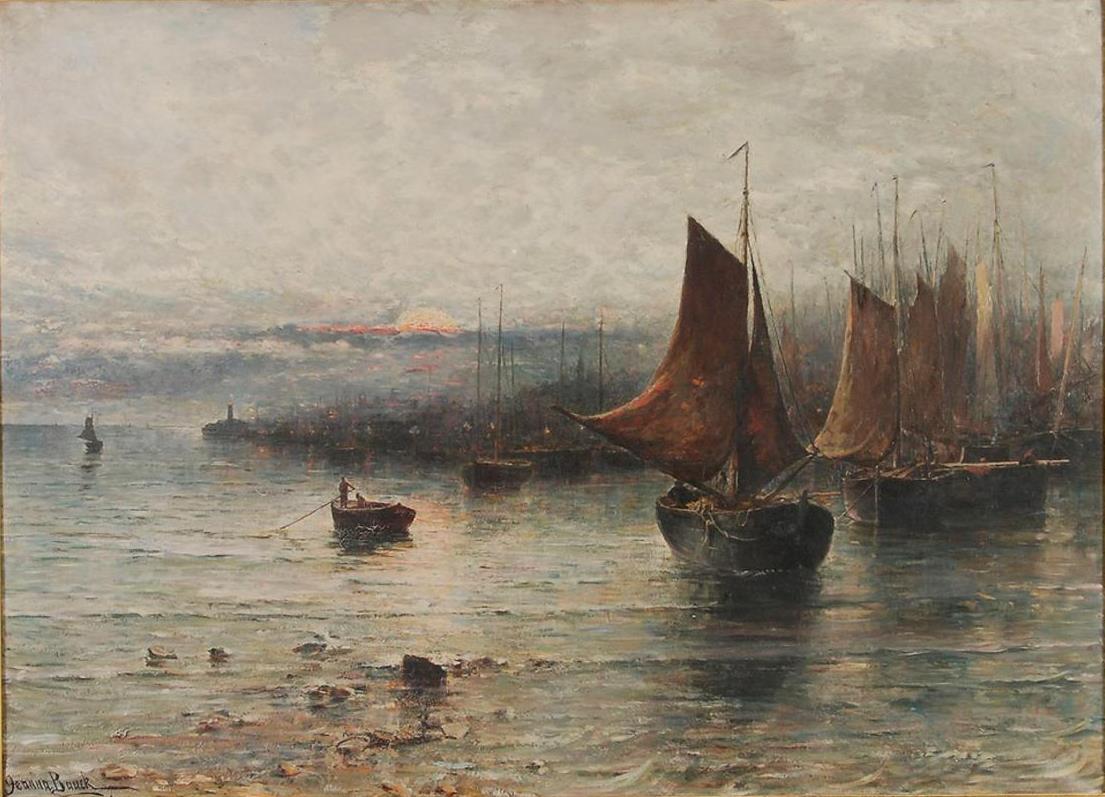
Bauck, Jeanna Maria Charlotta
1840, Estocolmo, Suecia - 1926, Múnich, Alemania
Shipping of the coast, n/d
Signed lower left: "Jeanna Bauck" (signature lost- partially)
Carmen Thyssen-Bornemisza Collection.
Oil on canvas
107 x 147 cm
CTB.2015.104
Artwork history
-
Private Collection, Redenham, Hampshire.
-
Dreweatts Est. 1759, Newbury, United Kingdom, lot 158, October 21, 2014, (listed as: Shipping of the coast).
-
Ansorena, Madrid, Auction n. 359, Lot 111, June 23, 24 & 25, 2015.
-
Carmen Thyssen-Bornemisza Collection.
-
-Illustrirter Katalog der Internacionalen Kunstausstellung im Königl, Glaspalaste, München, Sept. 1883, 4. Auflage, München [Rep. engraving, listed as “Abendstimmung am meere”]
-
– Sons. Analogías musicales en la pintura. Museu Carmen Thyssen Andorra [Exhib. Cat. Curator: Giró, P.], Ed. Fundació Museu Andorra (Museand), 2024. P. 20-21, 101, 112, 113 & 192 [Sheet by Pilar Giró].
Expert report
In 1863, Jeanna Bauck moved from Stockholm to Germany to study painting. She was a pupil of Adolf Ehrhardt, a prestigious professor at the Dresden Academy of Fine Arts, who produced a type of work immersed in a neoclassical style. She soon moved to Düsseldorf, where she attended classes with Albert Flamm. an artist whose favourite subject was almost exclusively ltalian landscapes that are striking for their faithfulness to nature, their careful execution and their brilliant and varied colour effects. lt was in Munich, however, that Bauck did most of her apprenticeship in landscape painting under the tutelage of Józef Brandt.
Her works are strongly influenced aesthetically by the artist Dietrich Langko. Critics associated this artist’s work with the tastes of the so-called Barbizon school, due .to his search for inspiration directly from nature and abandonment of academicism. In 1869, Langko had made a study trip to the Netherlands. Van Goyen’s landscapes and seascapes would leave their mark on his work, and these would do the same on Bauck’s.
This artistic training and aesthetic background is clearly visible in the work Shipping of the Coast that Jeanna Bauck presented at the lnternationalen Kunstausstellung im Konigl held in Munich in September 1883. At the beginning of her career, Bauck devoted herself almost exclusively to landscape painting. In this work we can perceive her artistic maturity, which leads her to find her own expression. In her quest to depict a landscape close to reality, free of frills and mannerisms, the specific nature of the subject is relegated to the background, giving absolute prominence to the atmosphere that she successfully, transfers to the canvas.
Bauck’s compositions are carefully constructed: the vertical cadence of the masts and the calm of the sails whisper the prelude to dusk in the harbour; the contrasting brushs on the sea, which draw subtle horizontal lines, suggest the constant movement of the waves and the mist conquering the sky and the sunset.
The artist’s sensitivity and her mastery of capturing light he instant place this work in an impressionist context. The title she used to present it in 1883 suggests this: Nocturne in the Seas. Seascapes are merely an excuse to play with the light at the moment when the last rays of sunlight awaken faint oranges and pinks on the greyish blue of the aquatic mirrow. Meanwhile, the first lights of the port begin to illuminate, breaking the darkness of the night and ushering in a new era: modernity .
Pilar Giró